
Reporting period:
SOLVIT is a network of 30 centres staffed by national civil servants, one per country (EU Member State plus Iceland, Liechtenstein and Norway). Since 2002, SOLVIT helps people or businesses free-of-charge when their cross-border rights in the Single Market are breached by public authorities. SOLVIT looks for informal, swift and pragmatic solutions to make sure the four freedoms of movement of people, services, goods and capital are upheld. It offers a faster, informal alternative to starting a court case, submitting a formal complaint to the European Commission or launching a petition.
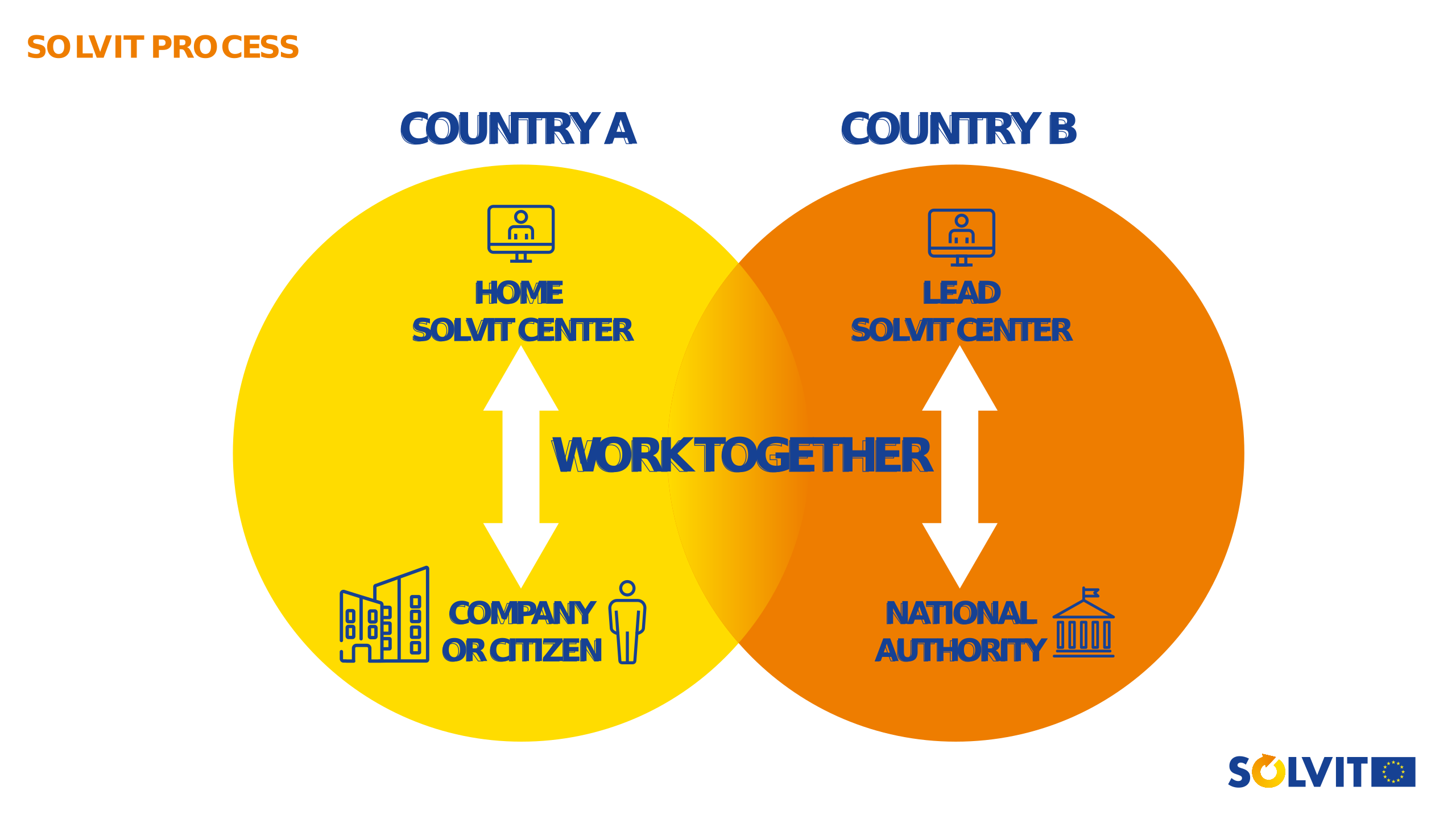
There are always two SOLVIT centres working on a case, ensuring checks and balances in complaint-handling. The centres work together via an online database. People and businesses who encounter obstacles exercising their rights can seek help from their home SOLVIT centre (usually in their home country) via an online application. The home SOLVIT centre prepares the case and sends it to the SOLVIT centre in the country where the obstacle occurred (the lead SOLVIT centre). The lead SOLVIT centre then contacts the national authority that is the source of the obstacle to solve it.
Main messages:
In 2025 SOLVIT received another record high number of complaints. Following a 32% increase in 2024, there was another 22% increase in complaints in 2025. Citizens and businesses submitted 7,941 complaints of which 3,612 cases fell within SOLVIT remit. The network solved 85% of the cases.
In addition to its primary role of solving cross-border problems for citizens and businesses, SOLVIT also assumed a pivotal role in supporting a well-functioning Single Market, by identifying systemic obstacles through the cases under its remit.
The Single Market Strategy recognises this role. To further strengthen it, it calls on the Member States in cooperation with the Commission to:
- Address systemic issues hindering the Single Market detected by SOLVIT;
- Reinforce the SOLVIT centres;
- Strengthen the support that SOLVIT could provide to businesses.
On systemic obstacles, the newly deployed repository of cases makes it possible to better capture and analyse the nature of systemic issues. This will facilitate the identification of obstacles and the monitoring of the follow-up. In 2025, the Commission compiled a list of 17 obstacles based on the repository. These obstacles have been referred to the competent administrations for appropriate follow-up and resolution. (see separate section). Member States and relevant Commission services are urged to address these issues.
On strengthening the SOLVIT centres the Commission continued its daily support to the network by directly advising on cases and legal issues, organising training sessions, developing the case handling interface, and raising awareness about the network among stakeholders.
Further strengthening is only possible when there is sufficient staff. The Scoreboard’s staffing overview measures how SOLVIT centres cope with their current caseload. The overall staffing situation has deteriorated compared to last year. This, combined with the ever increasing caseload, means that there is an urgent need to reconsider the overall staffing situation of the SOLVIT centres and determine the needs of each SOLVIT centre. To be noted that there has been over the years no significant increase of staffing to keep pace with the increase from 200 cases per year to the current 3,612 cases. As it is a cooperative network, the strength of the network as a whole is determined by its weakest link.
Strengthening support for business cases first requires enhancing the staffing of the centres. In addition, the Commission conducted a scoping exercise with SOLVIT centres of business cases. Based on the results of this analysis, the Commission will propose targeted actions in 2026 to attract more business cases to SOLVIT and leverage the network’s full potential for businesses and SMEs. Thirdly, SOLVIT has strengthened its cooperation with the Enterprise Europe Network to further develop its support for businesses.
SOLVIT main facts and figures
During the reporting period (1 December 2024 – 30 November 2025) SOLVIT received another record high number of complaints. The 32% increase in 2024 was followed by another 22% increase in 2025! In this reporting year the network received 7,941 complaints by citizens and businesses and accepted 3,612 cases falling in its remit.
The SOLVIT network solved 85% of these cases.
The SOLVIT centres with the greatest overall caseload both as lead and home centres are France (27%), Bulgaria (25%), Portugal (20%), Germany (18%), Italy (16%), Spain (13%), Greece (11%) and Hungary (10%).
Considering only caseload as SOLVIT lead centres, SOLVIT France (24% of all SOLVIT cases), Portugal (14%), Germany (11%), Italy (10%) and Greece (10% of all SOLVIT cases) are the centres with the highest workload having to contact their national authorities to solve the problems.
In 2025, the number of business cases treated by SOLVIT remained stable with 145 cases. Their share in the overall SOLVIT caseloads remains low compared to citizens cases (about 4%). SOLVIT Germany, Cyprus, Spain, Italy, Lithuania, the Netherlands, Poland, Belgium, Czechia, Estonia and Sweden are the centres that received most of the requests for help by businesses in their country for obstacles they encounter in other Member States.
The European Commission provided 37 pieces of informal legal advice to SOLVIT centres to help to deal with complex cases. The Commission is supposed to provide this advice within two weeks, but in many cases it takes longer. The average is 40 days (or 51 days when more than one DG is involved). The SOLVIT centres can also call on the Your Europe Advice service for help with the legal analysis of complaints. They have used this possibility 247 times for the cases closed in the reporting period.
SOLVIT cases by area of EU law
The majority of cases treated by SOLVIT still concern social security and free movement of people. The percentages are more or less the same as in the previous reporting period.
SOLVIT staffing
Staffing of national SOLVIT centres is crucial to the success of the SOLVIT network. The Single Market Strategy (2025)500, adopted by the European Commission in May 2025, recognises this and calls on Member States to reinforce their SOLVIT centres. Despite their dedication, some SOLVIT centres lack sufficient staff for their workload, experience severe staff turnover and/or have to prioritise other tasks over SOLVIT work.
This significantly impacts the quality and timing of case handling, the interaction with applicants and the overall efficiency of the network. This affects SOLVIT's performance. and it prevents SOLVIT from reaching its full potential.
The table below reflects the staffing situation throughout the full reporting period. Situations may have improved at the end of the reporting period, but this only partly counts for the final score in this Scoreboard. In 2025, insufficient staffing was reported for Austria, Bulgaria, Cyprus, Germany, Croatia, Liechtenstein and Portugal (orange) and in Greece, Finland, France, , Hungary, Iceland, Norway and Sweden (red).
Overall, to maintain the network and ensure it continues to function well, each Member State should consider whether further strengthening of staffing levels is needed. It should be noted that the SOLVIT centres, which have more or less the same staffing levels as in 2002, are now dealing with over 3,600 cases per year , compared to the 200 cases per year when the network started. It is not just the number of people that matters. Continuity of staff and the ability to dedicate 100% of working time to SOLVIT tasks are also crucial.
Legend
Staffing assessment
- red = Below 0: urgent action needed
- yellow = Between 0-2: needs improvement
- green = Above (excluding 2): sufficient
The total staffing score (which covers the full reporting period and does not reflect the status quo at the end of the reporting year) is calculated on the basis of the following indicators:
- continuity of case handlers (at least one member of staff has been working in SOLVIT for more than 2 years);
- large part of case handling relies on long-term staff;
- sufficient staff for current caseload;
- no other tasks in parallel (or overriding SOLVIT tasks);
- SOLVIT centre always operational;
- staff engages in awareness-raising/outreach activities;
- staff available for policy development, training, etc.
Assessment of staffing situation in SOLVIT centres
SOLVIT centres case-handling indicators
The 2013 SOLVIT Recommendation sets out for SOLVIT's internal procedures for dealing with cases. The timeliness of actions taken by the national SOLVIT centres depends heavily on staffing levels, significant increases in workload, the complexity of cases and the responsiveness of applicants, the relevant authorities, of other SOLVIT centres, and, in some cases, of the European Commission.
2025 Member States resolution rate of SOLVIT cases
In its Communication ‘The Single Market at 30’, the European Commission proposed ‘to set a benchmark on SOLVIT with the aim of solving a minimum of 90% of the cases within 12 months in each Member State’. This means that, to calculate the success rate in the reporting period, account has been taken not only of all SOLVIT cases closed, but also of cases open for more than 12 months by a SOLVIT centre acting as lead centre (centre of the country where the obstacle is encountered).
SOLVIT is equipped to solve individual cases of misapplication of EU law. ‘Recurrent’ cases (occurring numerous times) and ‘structural’ cases (where the obstacle results from a national rule) are referred to as ‘systemic issues’ and are difficult to be solved by an informal tool such as SOLVIT. These cases therefore negatively affect SOLVIT's functioning and success rate. Even if not solving them directly, SOLVIT does detect and monitor these systemic issues hindering the Single Market which must be addressed by Member States directly or by the Commission through its enforcement actions, as mentioned in the Single Market Strategy.
Success in meeting high resolution rates depends not only on the number of systemic cases but also on the willingness or possibility to cooperate by national authorities. In some instances, the lower resolution rate for some countries is indeed due to the fact that cases are linked to systemic issues that cannot be fully addressed by SOLVIT (e.g., pensions in Greece, residence rights in Portugal and Sweden) or to difficulties faced by the lead centre in cooperating with some national authorities.
That is why the success rate does not directly reflect SOLVIT centres’ performance. It should be seen as pointing at the respective Member State as it is the task of their national authorities, contacted by SOLVIT, to solve the cases.
SOLVIT’s average resolution rate remains impressive in 2025 at 85%.
To be noted that there is less statistical relevance of the resolution rate for countries with a low caseload as lead centre.
For more details by country, see the country data pages.
SOLVIT cases revealing obstacles
SOLVIT cases reveal most present obstacles encountered by citizens and businesses when moving or doing business across borders in the EU. SOLVIT’s role is primarily about helping citizens and businesses to have a right stemming from EU law recognised and benefit from it and, therefore, SOLVIT deals mostly with cases of misapplication of EU law. It should be noted that the obstacles detected are not all situations of non-compliance with EU law. They also encompass cases where relocating or doing business in another Member State is made obviously difficult.
To remove barriers and ensure SOLVIT is used at its full potential, the Single Market Strategy foresees that the Commission and Member States follow-up on the obstacles identified by SOLVIT.
The Commission has developed a new repository of cases to better capture and analyse the nature of these obstacles to address them. Based on this new tool, the Commission has identified a number of obstacles that hinder the effective operation of the Single Market.
Three main categories can be distinguished:
- Obstacles linked with long delays and difficulties with procedures. This concerns more specifically:
- payments or calculations of as well as applications for various social security benefits, in particular pensions and unemployment benefits, making it difficult for EU citizens who have worked and lived in another Member State to enjoy their social security rights;
- residence registration for EU citizens, which creates problems in handling daily affairs such as access to healthcare, exchange of driving licences and other public services;
- issuing decisions on recognition of professional qualifications and academic qualifications, preventing EU citizens from exercising their professional activities or exercising them at the appropriate level.
- Obstacles stemming from a national rule that seems a priori not compliant with EU rules. This concerns:
- a national law that requires newly graduates to prove the knowledge of the national language in order to apply for unemployment benefits;
- ID cards that are not recognised in another EU Member State because the cards in question do not specify who has issued the ID card;
- Insurance intermediaries obliged to pay in two countries where they operate membership to a professional organisation.
- The last group of obstacles concerns more particularly companies. This includes:
- long delays or difficulties in issuing social security forms for posting of workers;
- complex procedures resulting for example from confusion between notifications and prior authorisation before products can be put on the market; differences in how products are categorised, uncertainty about the applicability of the principle of mutual recognition to goods that EU law harmonises partly
- long delays in handling VAT returns;
- technical obstacles for non-national service providers in registering with a national based IT system that is established to fight against VAT fraud;
- difficulties with the cross-border recognition of national e-IDs.
These obstacles have been referred to the competent administrations for appropriate follow-up and resolution.
In the context of these collaboration, some of the obstacles identified have already been addressed. This concerns:
- Receiving a state subsidy for certain house works was made conditional on the use of a national service provider. The national law has been changed and this condition has been repealed.
- To facilitate the exchange or renewal of driving licences in a cross-border context and eliminate the long delays encountered, a new directive was adopted on 22 October 2025 and should be transposed in 2028.
- Difficulties encountered when registering a car in another EU Member State. The procedure will improve once the proposal for a revision of the current directive is adopted and transposed.
- Long delays in pension processing and in data transmission regarding insurance periods, which affect particularly mobile workers, are being addressed in one of the Member States where there has been a very high number of long delays. The issue is being monitored to assess if the implemented measures lead to expected results.
While it is dependent on the complaints it receives and therefore does not provide for a structured mapping of all obstacles across the Single Market, SOLVIT offers concrete and first-hand evidence on the most recurrent Single Market obstacles. Therefore, in addition to its primary role of solving cross-border problems for citizens and businesses, SOLVIT is transitioning from a purely problem-solving mechanism to a policy-shaping instrument, based on firsthand concrete evidence supporting a well-functioning Single Market, by identifying systemic obstacles through the cases under its remit.
Conclusions on SOLVIT
To keep ensuring SOLVIT success, and answering the call of the May 2025 EU Single Market Strategy for reinforcing SOLVIT as a tool to strengthen the Single Market,
Member States should:
- each assess the staffing situation of their SOLVIT centre and make a plan to ensure that their national SOLVIT centre:
- is adequately staffed;
- has sufficient authoritative power to influence other national authorities and,
- has access to EU and national legal expertise.
- address systemic issues hindering the Single Market detected by SOLVIT in their country.
SOLVIT centres should:
- increase as much as possible the efficiency and quality of case-handling;
- keep the information in the new repository of systemic issues detected by SOLVIT up-to-date;
- intensify networking with national authorities.
The Commission should:
- keep helping the strengthening of SOLVIT centres by providing trainings, advice, facilitating cooperation with other relevant bodies and supporting endeavours for adequate staffing;
- contribute its evidence on systemic issues to policy makers;
- finalise the revamping of SOLVIT database, update the case-handling manual and provide training on the new workflows;
- define the areas of business cases where SOLVIT can make a difference and focus awareness raising activities on the SOLVIT strong points;
- strengthen the cooperation with Enterprise Europe Network;
- strengthen cooperation with the ELA (European Labour Authority) to address systemic obstacles linked to labour mobility.
Success stories
For examples of SOLVIT success stories: see SOLVIT website.